Posts

Showing posts with the label stockton darlington

What's In A Name?

Image
Well, it would seem there's plenty of scope for confusion! Hopefully this post will deal with some of the oddities, rule out the absurd, and maybe even share a bit of the history; all coupled to recent progress. Kirkby Stephen East. Well, that's obvious, isn't it? The most easterly-located station in Kirkby Stephen. Meaning the other station (on the Settle - Carlisle) was called Kirkby Stephen West.  But for many years, such a distinction was unnecessary: it was either the North Eastern station or the Midland station, according to the operators of the lines in question. Even after the Grouping, the two stations were run by different companies, so the distinction between the stations fell in line with this: either LNER or LMS!  The issue only really arose after Nationalisation, when both stations serving Kirkby Stephen came under the control of BR, albeit different regions initially. In order to try and make it easier for their customers, the use of East and West came about,...

...Of Course We Don't Just Lounge Around

Image
It's been a little while since we built up some wooden benches to take the wire wheels we've recently been cleaning up, so we thought we'd tackle another 4. As well as testing them out for comfort! We use threaded bar to clamp the top to the legs, but to do this, we need holes that go all the way through. This has the additional bonus of preventing the timbers in the ground from splitting. Once the holes are drilled, threaded bar is pushed through, nuts and washers applied (ensuring the washers are positioned so as to look good...) before it is all tightened up. Three of the benches are seen here, almost ready for the Moles of KSE to set to and bury them. The left-hand-most bench will take the double dolly reading into the headshunt (beside the signalbox) or along the Tebay line. The next one that can be seen from the left will take the flat wheels for the wires from these signals so that the wires pass underneath the track. On the right hand side is the final bench of the ...

Cleaning and Painting

Image
For this project, there are lots of metal components which require cleaning up and painting. This is an activity that is particularly satisfying, and which several volunteers are carrying out, as and when they have a few minutes spare. All the equipment and paint is to hand, so it is a nice job to fall back on. This task also expands to cover the dismantling of seized components before they can be cleaned up and painted. There are lots of items  in all sorts of states! Will dismantling a clip (adjustable) crank into its component parts A selection of photos below gives some indication of what is involved, as well as the quantity required! Many thanks to all those who are putting in the hard work, particularly David, Jim and Will. Components before a healthy dose of red oxide A couple of compensators in their component pieces

Putting Up Shelves

Image
Putting up shelves normally requires some means of supporting them. Usually a bracket! In the case of the signal box, there is a shelf for all the instruments to sit upon, which is located above the lever frame itself! The brackets for this, that partner the CD frame, are fairly ornate and quite distinctive. Whilst we have brackets to support the lever descriptions that go behind the frame, low down, we do not have any original block shelf brackets. Brackets at Beamish A visit to Beamish (unrelated to the work at KSE...) resulted in 'spotting' three such brackets on the wall of a non-railway display! Subsequent discussions with Paul Jarman saw the loan of one of these brackets being agreed so that we could cast copies from it. For the signal box, we will require two such brackets, and having an original to work from was a much more appealing proposition than having to recreate them from scratch.  The loaned Bracket Discussions with the foundry ('our' excellent L...

The Rafters – Part 1

Image
A couple of nice days over the weekend saw the signalbox acquire a somewhat skeletal appearance as we added the rafters to the previously erected ridge beam – a string line top and bottom ensured that everything was nicely lined up end to end so that the tongue and groove close boarding that will sit on top will be nice and flat and provide a splendid base for the slates.  On completion of this task, someone suggested taking down the string lines until some ‘wag’ suggested that the rafters might follow! So we left them in place! It may look like an unorthodox build process seeing as we have not yet completed the gables, but the slope of the rafters is required for me to accurately build the gables to profile and also to position the very large wooden purlins that will bear a large part of the weight of the roof.  The rafters on the backside will require a little more tailoring, I think, as the original rear wall on which they will sit varies in thickness, is not perfectly stra...

The Gable Ends – Part 1

Image
Why, all those years ago, those constructing our signalbox decided to build three-quarters of it in random sandstone and then finish it in cream bricks, we will never know. However, true to our objectives to replicate the original, we will do the same and, with our time capsule embedded firmly in the last course of stone, the first few courses of bricks that will comprise the gable ends of the ‘box were laid. Attempts to obtain old bricks of a suitable age and colour locally met with no success, so a brickworks was commissioned to produce and age them accordingly with truly outstanding results that will enable us to build something that does look years old. As the gables rise towards their peak, we will build in the two sturdy purlins (roof supports) with the ridge beam siting on the peak itself. Watch this space!

The Moles of Kirkby Stephen

Image
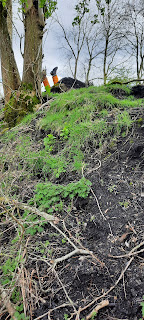
Another concrete bench recovery session: not to be confused with the quest to find my marbles. Or Will's dropped loose change. Honest!  Will's Feet Recently a lot of time has gone in to the lattice bracket signal in one way or another, but we were back digging (mining?) for  gold  concrete: trying to recover further concrete bench legs for reuse. The usual digging out happened fairly rapidly, but cutting the rusted remains of the securing bolts was tougher, and even when these were cut through we had problems. The bolts had blown with the rust build up and were wedged in the concrete. This required much more brute force (coupled with plenty of ignorance) to separate. Will cutting the bolts holding the concrete sections together . Whilst Steve was extracting his foot from the rabbit holes, I dropped down the embankment and discovered another couple of relics: an NER drive rod which would have pushed the signal arm to show an 'Off' as well as a back blind from the...

The String Line

Image
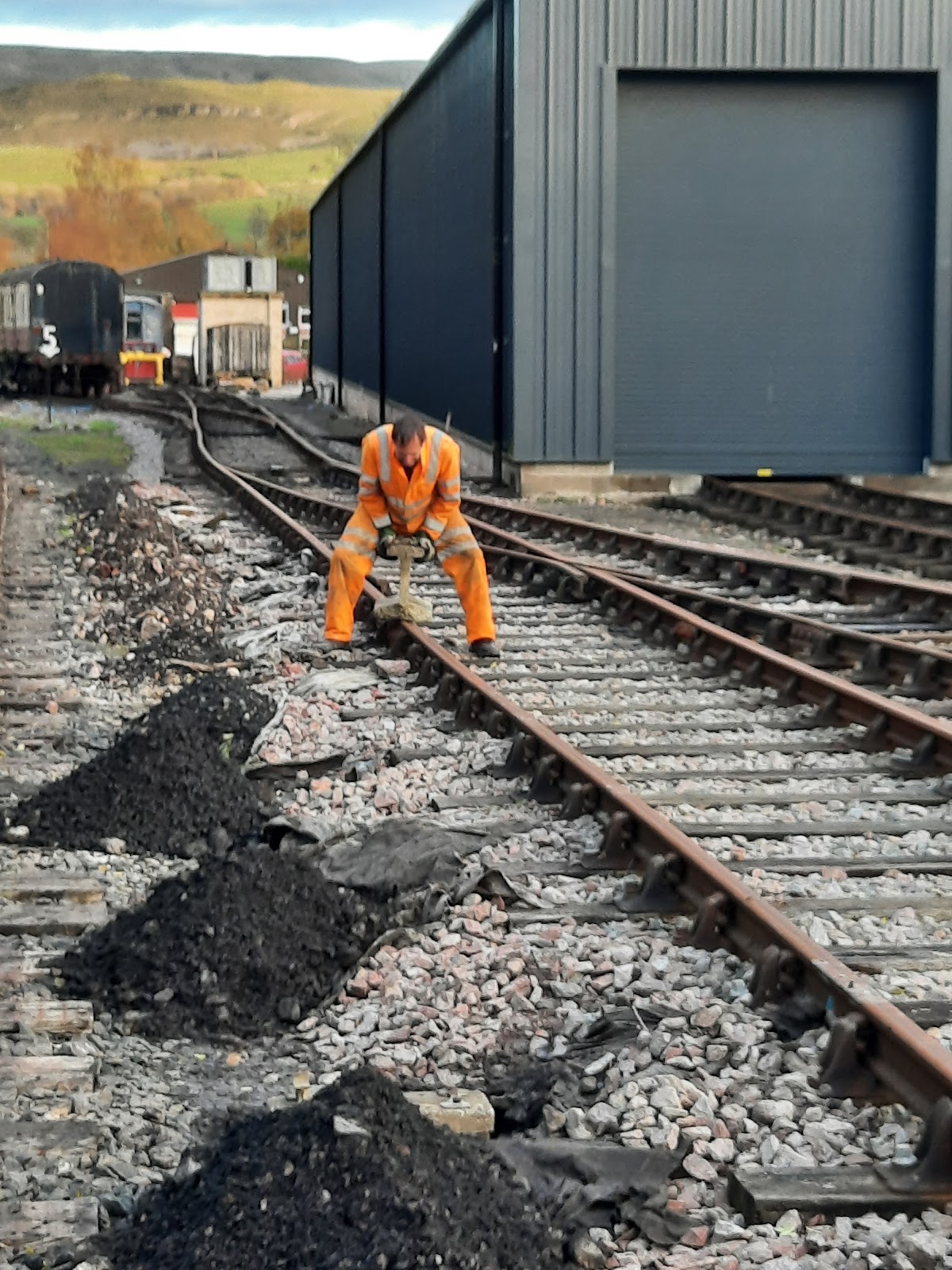
Our last report of progress centered on the rough planting of stools for the rodding run. We had dug holes at regular 9' intervals to approximately the correct depth, and deposited concrete stools into these excavations.  No need for a gym membership. Next comes the process for aligning and levelling them up: the straighter the rodding run, the easier it will be to operate as friction and strain is minimised, so the incentive is there to do it really well, once, and not have to keep coming back to alter it later on! First of all, we set the two ends of this stretch of rodding: the alignment is taken from the Tebay line, whereas the level is taken from the (slightly lower) Penrith / Eden Valley line. It had to be this way around, as the EVR line will be slewed slightly later on as part of Permanent Way (track) work associated with the project. With the Cumbrian weather having filled the stool holes, baling out was first required! Bailing Out With the ends set, we borr...

The Locking Room – Part 10

Image
A further report from Bob Tyson following the work that took place on Tuesday last week. Having placed the lintels in position, we have now brought the walls up to the full height required for installing the first of the two ‘string’ courses which will bring us up to operating floor level thus, in effect, completing the bottom half (the locking room) of the building. Each stage of the build brings its problems and each problem brings its solution. I will enjoy documenting these for you as they arise as I know there will be many more to come...

Almost Ready For The First ‘String’ Course

Image
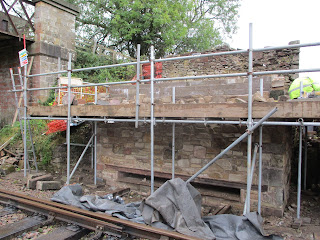
Hello blog fans! I hope that you're all well and managing to avoid this miserable weather. The signal box building team have been pulling out all the stops ( and some hair! ) since our last post and has at last succeeded in raising the stonework around the locking room door to the correct height to receive the lintels. This is really something of a milestone and has taken us a fair amount of time, but only because we have beavering away at the other three walls at the same time in order to bring all the courses of stone up relatively evenly. Once the mortar has set hard, we will mount the lintels and, for the first time in over 60 years, the ‘box will have an inside and an outside. We now have only a finishing course of stone to ‘top off’ the front wall to enable us to mount the first of the two ‘string’ courses which mark the clear division between the locking room and the operating room floor. Further progress is expected soon, and you'll be the first to know when it does.

The Locking Room – Part 6

Image
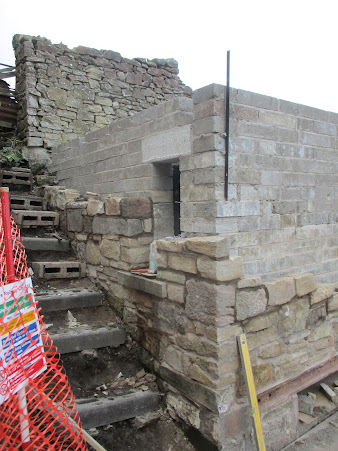
The weather has been kind to us today and the external walls of our signal box have risen inch by tortuous inch, like a phoenix from the ashes, as we spend several hours painstakingly selecting and fitting stone to stone in such a way as to make it appear random, or some may say, haphazard. The new stones match the lone surviving wall from the 1861 box remarkably well.   The work involved to achieve this effect is considerable, backbreaking and rewarding – all at the same time. We are intending to capitalize on this projected short spell of mild autumn weather and will hopefully be able to report further progress shortly, providing that is, our aching backs can take the strain. Many thanks to Bob for the update.