Posts

Showing posts with the label s&d

The Arms Race Is On! (Part II)

Image
Following on from the previous blog post, dealing with the problems we found with the CD signals and the research, we set to, and trimmed a main arm down by 6", with the ability to take off another 6" if need be, later*. Having chopped it down, a test was in order, which necessitated the removal of the arm we'd fitted to the Fixed Stop signal at the top of the site. This should have been very simple, but we found the paint had stuck the washer plate onto the arm. We just left it attached, deciding that we could attack it on the ground, later if need be! Shortened arm in place, and looking better-proportioned than the 'technically correct' version! The shortened arm (measuring at 4' projecting beyond the post) was slotted in and secured with a single bolt. And it returned to the horizontal position perfectly, on its own! Success!! Sadly we couldn't just leave it like this, and took it back indoors so that it could be fully painted. The opportunity was taken...

More Boring Jobs

Image
A new progress update from Tim:  Readers of my ramblings may well remember the posts alluding to all the new castings of NER Central Division signal components. They may also recollect the preparations carried out to the wooden signal posts in order to accommodate the said castings... Routing out the signal posts Well, after much avoidance of setting to and drilling out the castings, ready for f tting up, things got serious! In the machine shop, the radial arm drill has been commissioned, and appropriate training carried out. The raw castings, as collected from the foundry, but left to weather, slightly. The castings were cleaned up and marked for the hole centres whilst suitable clamping arrangements were devised for the work. The first front bearing casting, clamped down onto a couple of spacers to raise up from the bed and prevent damage drilling through. The four mounting holes were drilled in one go, once the centres were marked and double (triple!) checked, but the centre piv...

Really looking like a Signal Box now!

Image
The fitting of the steps of the S&DR Signal Box signifies that we are fast approaching the final stages of the build. We have yet to complete the wheelchair access platform at the top of the steps which will allow access to the ‘box from the newly constructed footpath.  Some cosmetic work at the foot of the steps will have to wait until Tim and his redoubtable signalling team have installed a plethora of point rodding, pulley wheels and bell cranks, all of which, will eventually determine exactly where we need to place the first step.  We hope as many of you as possible will visit over Easter when you can see at first-hand the work we have been doing.

More Ground Signals... 2 in 1!

Image
The previous post featured an LNER-pattern ground signal: this is an LMS-pattern variant. As mentioned quite a while ago, this is very in-keeping for Kirkby Stephen, as they were used here from the 1950s. The LNER-pattern are upper quadrant, as opposed to the lower quadrant LMS...  This signal (above) will control movements into the Bay platform or the Tebay platform, from the point ends, to allow greater flexibility with shunting. Standard convention dictates the uppermost disc refers to the left-hand-most route, therefore the top is for the Bay, and the bottom for the Tebay platform. This was another bench building, mole-digging type of affair. They're quite common throughout this part of the project!! Between Dave, Alex, Steve and I, the ground signal was planted and bolted down at one corner, just in time for the Open Weekend, complete with temporary discs attached. We will be getting a batch of new discs made a little later. This just left the rest of the bolting down to be co...

Welsh Slate

Image
We have at last managed to get 4 coats of paint onto the fascia boarding of the signalbox and the attendant woodwork, leaving us free to commence slating the roof at last. We were keen to create a period look and therefore opted to use reclaimed welsh slates some of which I would guess have already seen many years of service, but were still good for many more. In the past as you will recall that rain has, on many occasions, brought work to a frustrating standstill and created havoc with work we thought was complete. That being said, slating is one job you can carry on with rain or not and so we did on Tuesday, ignoring the showers, getting wet, and revelling at being able to stick two fingers up at the weather. It is not going to improve much at this time of year so I suppose we will get several more soakings before the roof is watertight but I will tell you about them in due course.   

Ash, Slag, Clinker, Bricks, Wire and all sorts:

Image
  ...The Things You Find When Digging Holes! Whilst Matt has been concentrating on the signal wire stakes (see other posts), we've also been trying to work our exactly where to place the wooden benches that will carry the flat wheels. These take the signal wires through (approximately) 90° to route underneath the track; from the wire run to the signals themselves. The first such bench we chose to make needs to take 9 wires, and is one of the more awkward to position. Why so many wires? Well, that's a story for another day, although we have alluded to dual control of certain signals between the West (S&D) box and the Junction box... Having determined the location (driven by the signal locations, sleeper spacings and consideration of walking routes and future projects), we roughed out a bench top, using some seized flat wheels to look at alignments. This determined the length and width of the bench we needed, and allowed us to cut the timber. We opted to drill right through, ...

Cleaning and Painting

Image
For this project, there are lots of metal components which require cleaning up and painting. This is an activity that is particularly satisfying, and which several volunteers are carrying out, as and when they have a few minutes spare. All the equipment and paint is to hand, so it is a nice job to fall back on. This task also expands to cover the dismantling of seized components before they can be cleaned up and painted. There are lots of items  in all sorts of states! Will dismantling a clip (adjustable) crank into its component parts A selection of photos below gives some indication of what is involved, as well as the quantity required! Many thanks to all those who are putting in the hard work, particularly David, Jim and Will. Components before a healthy dose of red oxide A couple of compensators in their component pieces

Benches II - Sitting Around Idly?

Image
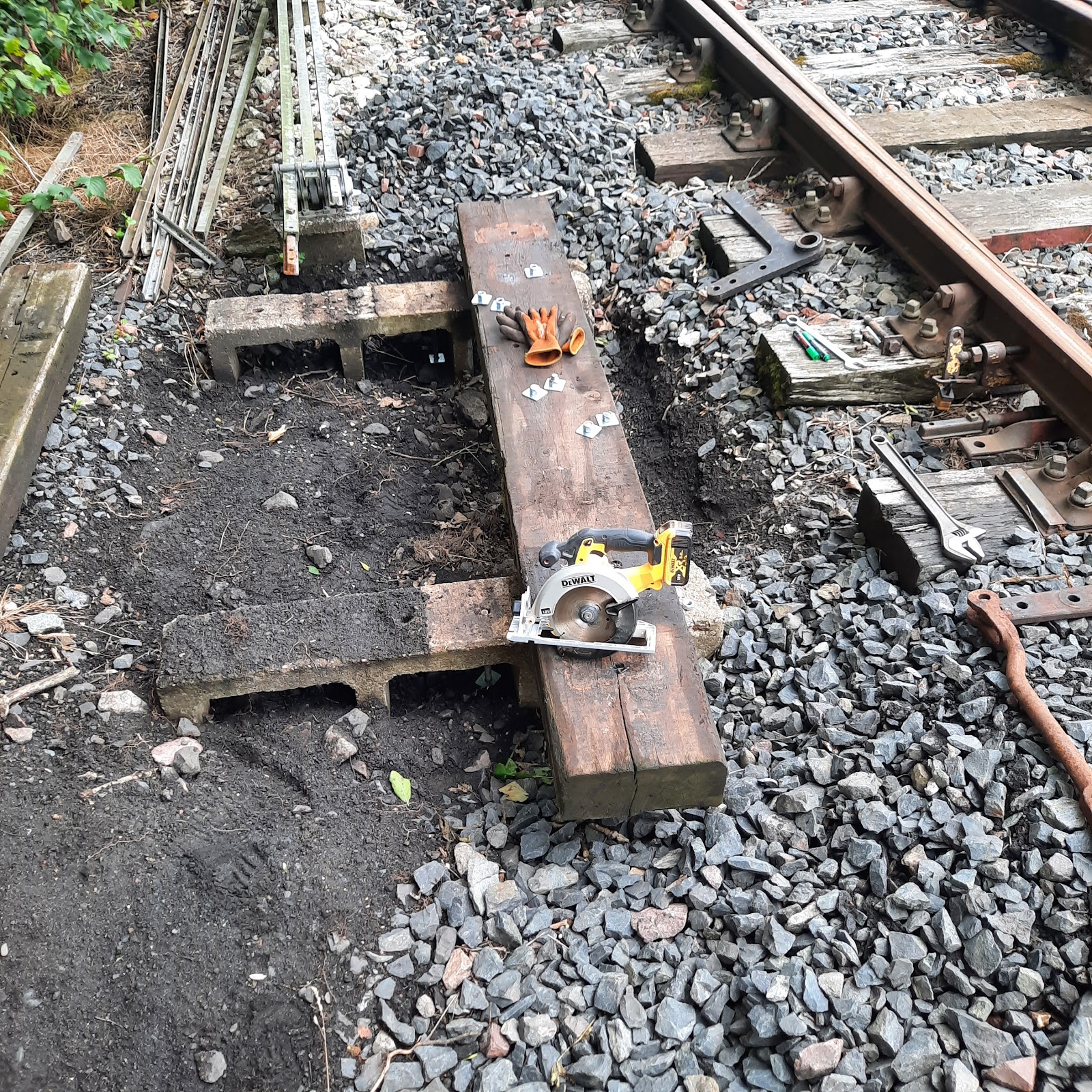
Following on from the previous instalment on benches, we had a discrepancy in height to tackle on the first bench along from the Junction ground frame. This was due to the bench top being a thicker sleeper than we had anticipated. Fortunately, we were only 1" out, so it was a quick case of marking up where the concrete legs touched the timber (allowing a bit of leeway), then flipping the timber over to cut out enough to allow the whole lot to sit lower. The alternative would have been to dig out the legs completely, then dig out even more underneath, before levelling them up again. We didn't fancy that in the slightest!! A battery circular saw was used to make multiple cuts across the timber, before the hammer and chisel were deployed to chisel out the excess timber. Once both sides were suitably rebated, the timber was flipped back over, levels checked and attempts made to push the threaded bar back through the holes. This was a bit fiddly, but accomplished the moment additio...

Stake and Chips

Image
 ...no, not that kind of steak... nor the type used to dispatch vampires (although they are a similar shape)! A pile of recovered stakes In order to operate the semaphore signals from the box, wires are connected to the levers and run along to the signals by means of flat wheels (to change direction) and pulleys (held on posts) to travel the distance. It is these posts we are (well, primarily Matt is) installing. We recovered a large number of concrete wire stakes from Norfolk as part of a joint exercise in cooperation with various parties. Some of these had wire pulleys (or the remains of those) still attached. Timmy supervises the installation of the stake (whilst keeping well away from Barras) Having decided the principal routing for the signal wire runs, these stakes have been spaced along the run to support the wires for the signals. It is then a case of digging out holes in the ground to plant them in. It would be far easier to just stab them into the terrain (as the name sug...

The Rafters - Part 3

Image
Further progress has been made with most of the rafters now settled in place with just a little ‘truing up’ required here and there due to the fact that the majority were either twisted of bent. The sun shone a little brightly today (never happy are we!) and, by 2pm, a temperature of 24°C was crisping our skin as we fitted our last rafter of the day and called time. With the big, heavy purlins now firmly secured in position, we will proceed to construct the gables to their full height thus completing another important phase of the building – hopefully later this week. Keep watching!

The Rafters – Part 2

Image
Construction has begun once again on the signal box as the hand-carved decoration on the ends of the purlins has been completed allowing us to set them in position on the gable ends and begin cutting and fitting the rafters to the rear section of the roof. I think I mentioned previously that these rafters would require more than a little ‘fiddling’ to get a good fit and so it has proved. This has been compounded by the fact that the ridge timber, after a few weeks exposure to the Cumbrian sun and rain, has developed a marked twist at one end (please see the photo) which we will also now have to accommodate. Despite these irritations, we have now managed a satisfactory fit of a rafter at each end of the ridge leaving another nine required to fill the gap. I will keep you posted.

The Fireplace

Image
The small fireplace with the skewed chimney stack that we always knew existed in the signalbox, but not its exact size or design, has now been completed after much debate, numerous rejections and several failures. Viewing the completed structure, you could be forgiven for thinking that it was much ado about nothing! After all, just how much work can building a small, plain, brick fireplace consist of? Well, let me tell you, there was absolutely no room to work with as the footprint of the fireplace was determined entirely by the small, supporting arch underneath (regular readers will remember from earlier blogs that this itself was in a terrible state prior to our comprehensive repair of it). It was on this that we had to fit the complete fireplace and flue, the dimensions of which are important for a proper draught. The original flue was intended to be contained within the 18 thick rear wall, except we discovered at the last minute that the rear wall was 18 thick at one end but, at th...

Wibbly – Wobbly Mock-Ups

Image
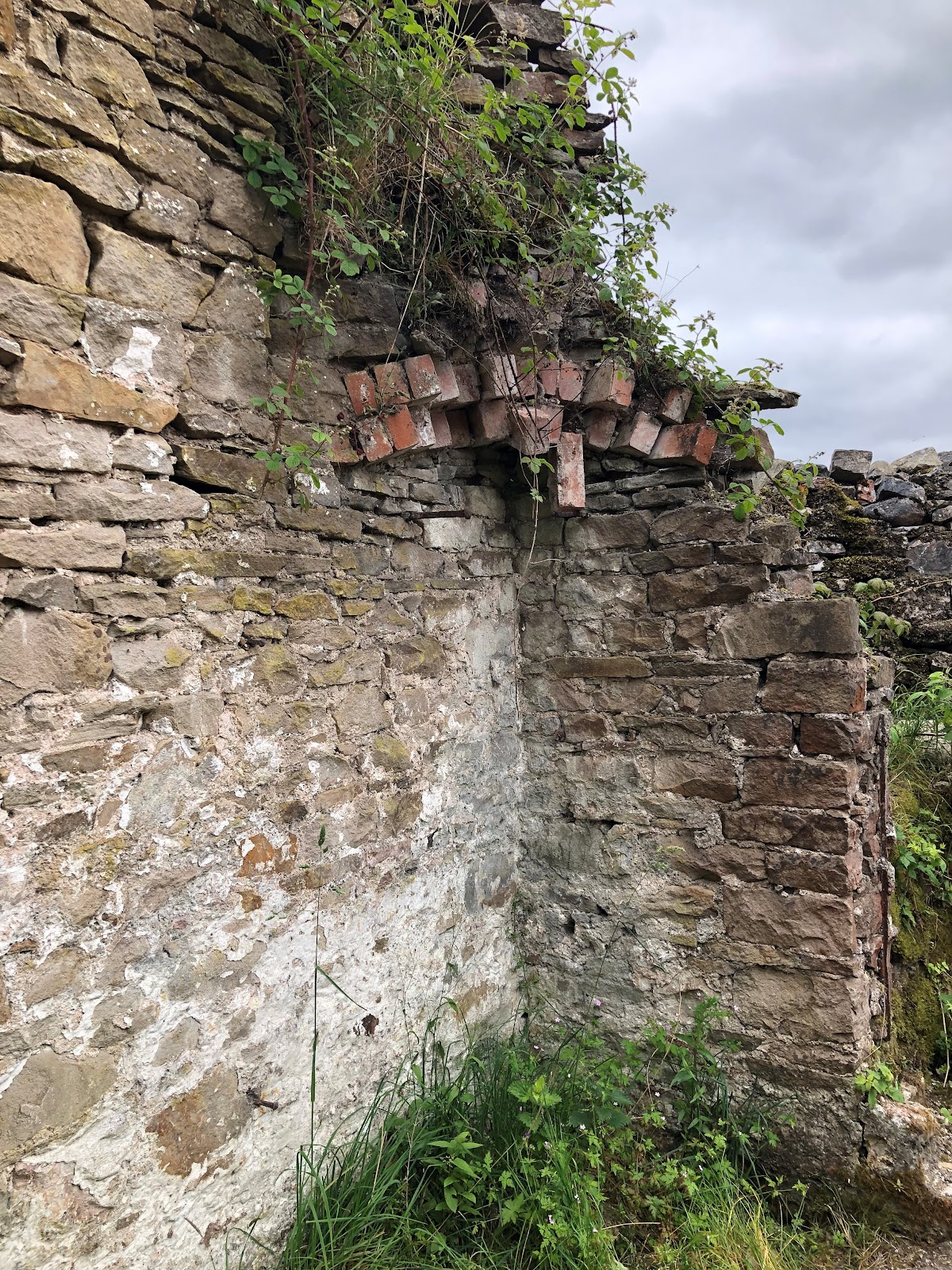
Things are a little quieter at the moment as we wait for our joiner to install the windows. So, our attention has turned to trying to reconstruct the tiny fireplace that we believe sat in the corner of the signalbox. All we had to go on was a semi-collapsed pile of soot-stained stone and the archway of bricks underneath that theoretically supported it. As you can see from the first photograph, the arch itself was in a terrible condition with bricks falling out like rotten teeth, so a comprehensive repair was undertaken to remedy this (Photos 2 and 3). We know that many signalboxes were heated with a cast iron stove, but the soot stains on the chimney we can see with the one photo we have of the building convinced us that a proper fireplace was the way to go. The arch bisects the corner of the ‘box meaning that the fireplace it supported did the same and, after building a rough mock-up, we realised just how tight the space for the chimney was going to be – especially bearing in mind tha...

Completing The Second ‘String’ Course

Image
A glorious spring day on Monday enabled us to set in place the final pieces of the upper string course of the signalbox with a team of 6 volunteers persuading the large, heavy, awkward, expensive, contrary, will-not-cooperate lumps into their final position! This marks another milestone and brings us very close to completing all the stonework – with just the corners of the two string courses for our stonemason to deal with and a small section in the fireplace corner to finish. When this is done, hopefully later this week, Rick, our joiner, will measure up for the heavy timber framework that will eventually contain the sliding sash windows and also support the roof. While Rick constructs this, we will pursue a myriad of other jobs including finishing pointing the back of the rear wall, fitting the remaining floor joists, setting out the chimney breast and fireplace and clearing all the remaining stone off the scaffold so that it can be raised. The list is long and seems to get longer, r...